
eCommerce Email Deliverability Consulting Services
On this page
eCommerce email deliverability consulting services are for online stores whose order confirmations, shipping updates, cart reminders or campaigns stop reaching the inbox. The top services separate transactional mail from marketing, authenticate every platform that sends as the store, prepare the domain before Black Friday volume, and keep checkout sign-ups clean. Below are the options, what each one suits, and the questions to ask any of them.
Online stores usually go looking for help after a symptom they can see: customers saying order confirmations never arrived, a support queue full of “where is my order”, or campaign revenue falling while the list keeps growing. Yeevu publishes this guide, and three of the services listed are Yeevu’s own (Yeevu, HelpWithEmails and YeevuFix), so weigh those entries accordingly. For Shopify’s own settings, Klaviyo on Shopify and Shopify’s order notifications in detail, see Shopify email deliverability consultants.
What eCommerce email deliverability consulting services cover
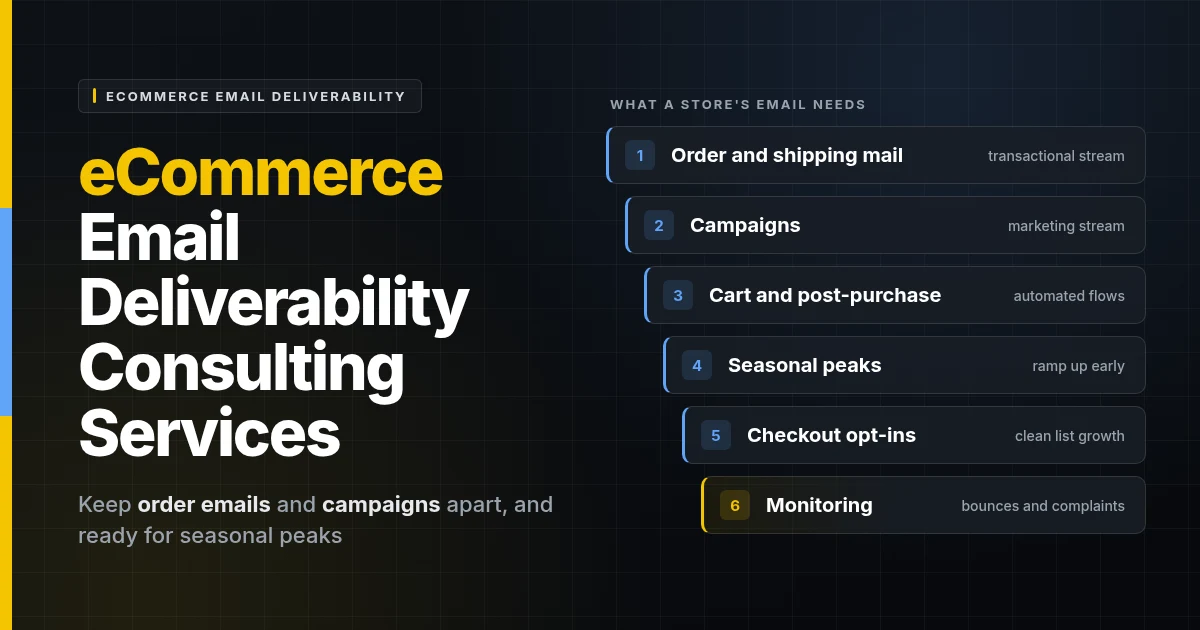
They cover the four ways a store’s mail differs from an ordinary business’s: two kinds of mail with opposite risk, automated flows that run all year, seasonal spikes in volume, and a list that grows at checkout.
Separating order mail from marketing: the core of eCommerce email deliverability consulting
Order confirmations, shipping notices and password resets are expected and rarely reported as spam. Campaigns go to far more people and draw most of the complaints. When both leave from the same address, the campaigns set the reputation the receipts depend on.
Google’s sender guidelines recommend the same From address for each category of message (one for receipts, another for promotions) and, where a sender uses several IP addresses, a different one for each message type. Consultants usually go further and give each stream its own subdomain: the store platform or a transactional email service on one, the marketing platform on another. Gmail still counts every message from the store’s primary domain toward its 5,000-a-day bulk-sender threshold, so the split protects reputation without escaping the bulk-sender rules.
The platform decides how much work this is. A hosted platform sends order mail from its own infrastructure once the domain is authenticated. WooCommerce hands order emails to WordPress, whose wp_mail() function uses PHP’s mail() by default, so unless an SMTP or email-API plugin is configured, receipts leave from the web server with whatever reputation that server has. WordPress’s own documentation notes that a successful send does not mean the email was received.
Abandoned-cart and post-purchase flows in eCommerce email deliverability consulting
Abandoned-cart reminders, browse follow-ups, review requests and win-back emails are automated, triggered by behavior and sent every day, so a fault in one keeps repeating until someone notices. Gmail’s sender FAQ says recipients, not Google, decide whether a message is promotional or transactional. A cart reminder with a discount code reads as marketing to the person receiving it.
That has two practical consequences. First, these flows belong on the marketing stream, carrying the one-click unsubscribe that Gmail requires on marketing and promotional mail from bulk senders; transactional messages are exempt. Second, promotional content should stay out of the transactional templates. Under CAN-SPAM, the FTC’s primary-purpose test treats a message as commercial if a recipient reading the subject line would likely conclude it contains an advertisement. A cross-sell block in a shipping notice is the usual way that line gets crossed.
Black Friday volume: eCommerce email deliverability consulting before peak season
Peak season is where eCommerce deliverability is won or lost, and the work has to start weeks before it. Google advises senders to increase volume slowly: the more mail sent, the more slowly volume should rise, and Gmail tracks volume, feedback and limits per domain and per IP address. A store that sends ten times its normal volume in Black Friday week, much of it to subscribers who have not opened anything in months, is asking Gmail to trust a pattern it has never seen.
- Ramp volume up through October and early November so the peak is a step up, not a cliff.
- Mail engaged subscribers first. Reactivating a dormant segment in peak week is the most common source of a complaint spike.
- Watch the spam rate daily in Postmaster Tools. Gmail wants it below 0.1% and never at 0.3% or higher. A bulk sender above 0.3% cannot ask Gmail for mitigation until the rate has stayed below it for seven consecutive days, longer than the whole Black Friday to Cyber Monday weekend.
- Know that bulk-sender status is permanent. A store that crosses roughly 5,000 messages to personal Gmail accounts in one day, even once in November, is treated as a bulk sender from then on.
Checkout opt-ins that grow an online store list lawfully
Checkout is where most store lists grow, and it decides whether the list is lawful and clean. Shopify’s checkout, for example, lets a store preselect the marketing checkbox region by region. Under the GDPR, Recital 32 says pre-ticked boxes do not constitute consent, so in consent-first markets the box should start empty. In the UK, PECR’s soft opt-in lets a store email existing customers about similar products, provided they were offered an opt-out when their details were collected and in every message since. Checkout addresses also carry typos, and a mistyped domain usually turns into a hard bounce on the first campaign.
Stores that sell across borders face different consent rules in each market, covered in international email deliverability consulting.
How eCommerce email deliverability consulting works, step by step
A good engagement starts with evidence and ends with a written record.
- List every sender: the store platform’s notifications, the marketing platform, the transactional email service if there is one, the helpdesk, review and subscription apps, and staff mailboxes.
- Baseline the reputation: SPF, DKIM and DMARC results and alignment on a real receipt and a real campaign, spam rate in Postmaster Tools, blocklist status, and bounce and complaint rates per stream.
- Fix authentication and split the streams onto their own addresses or subdomains, keeping the SPF record within its ten-lookup limit.
- Review the flows and the list: consent source, suppression of hard bounces, sunsetting of long-inactive subscribers, and unsubscribe handling.
- Test placement at Gmail, Outlook and Yahoo, before and after.
- Plan peak season: a volume ramp and a monitoring routine for the weeks around Black Friday.
Measure the result by clicks, orders and placement tests rather than opens. Apple Mail Privacy Protection, introduced in 2021, hides when a message is actually opened and inflates open rates, so a rising open rate can hide a deliverability problem.
Top eCommerce email deliverability consulting services compared
Not every option is a consultancy: some are platforms a store’s own team runs. The figures come from each provider’s published pricing.
| Service | Type | Price | Best for |
|---|---|---|---|
| Yeevu (Yeevu’s own) | Hands-on deliverability service | Free audit, then a written quote | Stores that want every stream diagnosed and fixed |
| HelpWithEmails (Yeevu’s own) | Email deliverability and marketing setup | Quoted per job, in writing | Klaviyo, Mailchimp, Brevo or MailerLite setup, with placement tested after the fix |
| YeevuFix (a Yeevu brand) | Fixed-scope, fixed-price fixes | Basic Audit $180, Full Audit $399 per domain | Small stores with one specific problem |
| Validity | Enterprise deliverability platform and Sender Certification | Quote only | Large marketing teams |
| Inbox Monster | Enterprise email and SMS testing | Deliverability suite from $15,000 a year | Large consumer brands |
| GlockApps | Self-serve placement and spam testing | Free plan; $85–$185 a month | Stores with someone in-house to act on results |
Yeevu runs a free email deliverability audit, then quotes remediation in writing. Its engineers work across Google Workspace, Microsoft 365 and the major email marketing and CRM platforms, and the engineers who configure a setup are the ones who support it. HelpWithEmails, Yeevu’s own deliverability service, sets up the sending domain inside the marketing platform, cleans the list before the first send and ends every job with a written report. Its inbox placement promise is on stated terms: the quote names the mailbox providers the placement test covers, the test runs after the fix, and if mail lands outside the inbox, work continues at no charge until the test passes. YeevuFix‘s Full Audit adds blocklist checks and spam-placement reporting to the Basic Audit. Validity still sells Sender Certification to high-volume senders, and a GlockApps test sends to 115 seed addresses. More providers are compared in the top email deliverability companies, and stores sending at scale should read high-volume email deliverability consulting. Whether a store needs a deliverability consultant or an email marketing agency is covered in deliverability consulting versus an email marketing agency.
eCommerce email deliverability consulting results: an online store’s notifications
Yeevu’s published e-commerce customer result shows the kind of problem this work solves. An e-commerce business needed dependable transactional notifications and stronger controls around its sending identity. Yeevu reviewed the sending environment, corrected the authentication and alignment issues affecting delivery, and validated the essential notification journey. Reliable transactional delivery was restored and protection against domain abuse was strengthened. The technical records and test evidence are kept private.
How to choose consulting for eCommerce email deliverability: six questions
The right questions test whether a provider understands stores, not just email.
- How will order mail be kept apart from campaigns, and which platform sends each?
- What is the plan for peak season: the ramp, the segments mailed first and who watches the spam rate that week?
- Which flows count as marketing, and do they carry one-click unsubscribe?
- How is consent captured at checkout in each market the store sells into?
- What do they promise? No provider controls where Gmail or Outlook places a message. A promise is only worth something with a named test and a stated remedy.
- Is every change written down, so the next app the store installs can be added without breaking the rest?
Book eCommerce email deliverability consulting with Yeevu
If order emails are going missing or campaign results have dropped, send Yeevu the store’s domain and the platforms it sends through. The email deliverability audit delivers a written report within 5–7 business days, with a severity rating for each issue, a prioritized fix list and a roadmap for rebuilding reputation. The email deliverability services then carry out the fix.
Book a free 30-minute consultation to go through where the store’s email stands before the next peak season.