
Email Deliverability Consulting Guarantees
On this page
Email deliverability consulting guarantees that promise higher open rates cannot be honestly given. No consultant controls where Gmail, Outlook or Yahoo place a message, and since Apple Mail Privacy Protection arrived in 2021, open rates no longer measure reading reliably. An honest guarantee covers something that can be tested, such as inbox placement in a named test after the fix, and states what happens if that test fails.
If you run a business or a marketing team whose campaigns have gone quiet, “guaranteed open rates” is exactly what you want to hear. The offer is easy to make and easy to appear to meet, which is the problem. This guide explains why the metric cannot carry a guarantee, what a guarantee with real terms looks like, and the warning signs in offers that promise more than any consultant can deliver.
Why no email deliverability consulting guarantee can cover open rates
No email deliverability consulting guarantee can cover open rates, because the consultant controls neither where a message lands nor how opens are counted.
Placement is decided by the receiving mailbox provider. Google says plainly that it does not accept allowlist requests from email providers and cannot guarantee that messages they send will pass Gmail’s spam filters. If Google will not guarantee Gmail placement for a sender, a consultant cannot either. What a consultant can control is the sender’s side: authentication, infrastructure, list quality and sending behavior. Those improve the odds. They do not bind the receiver.
Whether a delivered message is opened depends on the subject line, the timing, the relationship with the reader and whether they wanted the mail in the first place. None of that is a deliverability setting.
How Apple Mail Privacy Protection inflates open rates
An “open” is recorded when a tiny tracking image in the message loads. Apple announced Mail Privacy Protection in June 2021, and Apple says it “prevents senders from seeing if you’ve opened the email message they sent you.” In practice, Apple loads that tracking image on the reader’s behalf. Mailchimp’s own help pages explain that, with Mail Privacy Protection turned on, messages in Apple Mail are reported as opened regardless of what the contact did.
The result runs both ways. Opens from Apple Mail users can be counted when nobody read the message, and readers whose mail app blocks images can read a message without an open being counted. An open rate is still a rough trend line within one list over time. It is not a measurement precise enough to guarantee, and a guarantee pegged to it can be met without a single extra person reading anything.
What an honest email deliverability consulting guarantee covers
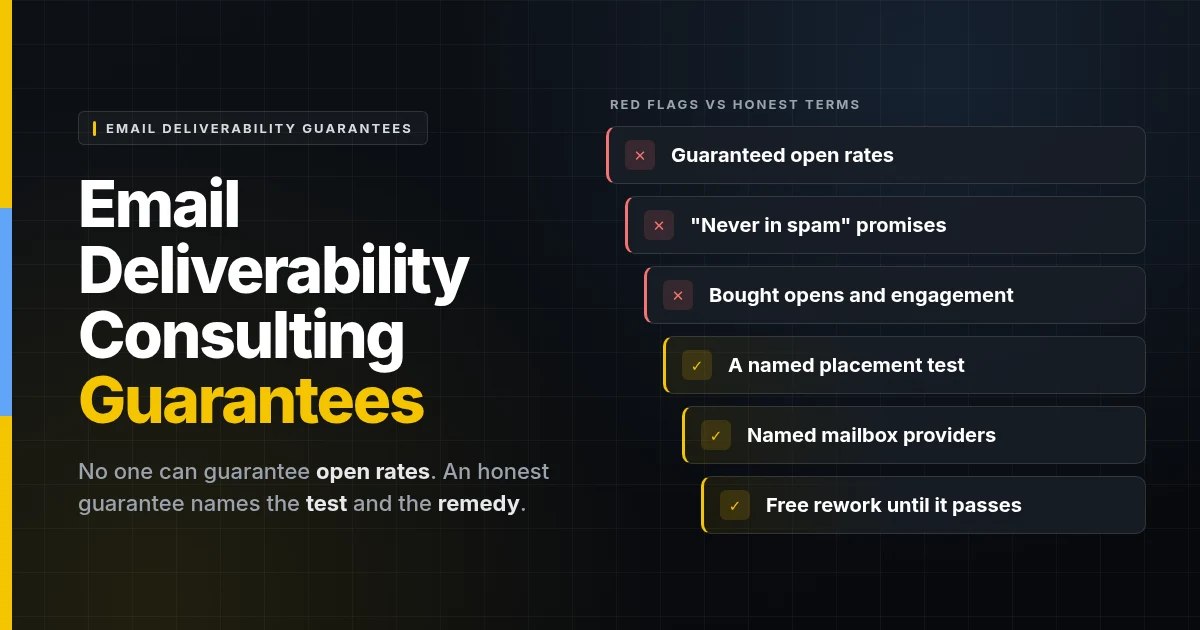
An honest email deliverability consulting guarantee covers a result that can be tested at a stated point, by a stated method, with a stated remedy if the test fails.
In practice that means three things written into the quote before the work starts:
- The test. What is measured, such as whether test messages land in the inbox rather than spam, and when the test runs.
- The scope. Which mailbox providers the test covers: Gmail, Outlook, Yahoo, and where it matters, the corporate security gateways your customers use.
- The remedy. What happens if the test fails. The meaningful remedy for technical work is that the work continues until the test passes, because a refund leaves the problem in place.
Everything outside those terms, such as how placement moves months later when the list, content or sending volume changes, is not something a consultant can promise. A good one says so in writing.
HelpWithEmails: an email deliverability consulting guarantee on stated terms
HelpWithEmails is Yeevu’s own email deliverability service, so weigh this example accordingly. Its inbox placement promise works like this: the quote names the mailbox providers the placement test covers; the test runs after the fix; and if mail lands outside the inbox, the work continues at no charge until the test passes. The same applies to warm-up, where live sending starts only after a placement test to the named providers passes. Delivery through corporate security gateways such as Proofpoint, Mimecast, Barracuda and Microsoft Defender is tested too, when those gateways are named in the quote.
Notice what it does not promise: open rates, click rates, revenue, or where any individual message lands after sign-off. Every job ends with a written report of what changed, with the test evidence. The terms are set out on the HelpWithEmails email deliverability page.
Red flags in guaranteed-open-rate email deliverability consulting offers
The red flags in a guaranteed-open-rate offer all come down to one question: whose behavior produces the number that the guarantee is measured on?
Seed-engagement networks counted as proof of opens
Some services send your mail to a network of mailboxes they control, where it is opened, moved out of spam and marked as not spam. Warm-up networks have a legitimate job building sending history on a new mailbox. The problem starts when opens from those mailboxes are counted as proof that customers are reading. They describe the vendor’s accounts, not your list, and Gmail’s spam rate is calculated from how real recipients react to your mail.
Bought opens and automated clicks that inflate engagement
Opens and clicks can be generated without a person: bot traffic, click farms, or security scanners that follow every link in a message before it reaches the reader. An offer that guarantees an open or click rate without explaining how genuine engagement is separated from these can meet its promise while revenue stays flat.
Other warning signs worth walking away from:
- “100% inbox” or “guaranteed Primary tab”. The Gmail Promotions tab is part of the inbox and follows the type of message, and no one can promise the spam filter’s verdict for all future mail.
- “Whitelisting” with Gmail or Microsoft. Google does not accept allowlist requests from email providers.
- A new domain as the fix. Starting over on a fresh domain moves the problem rather than fixing it.
- A refund as the only remedy on technical work. A refund does not fix the records. Continued work until a stated test passes does.
- No access for you. If you cannot see the Postmaster Tools data, DMARC reports and test results yourself, you cannot check the claim.
Metrics to hold email deliverability consulting to instead of a guarantee
The metrics that show whether email deliverability consulting worked are the ones the mailbox providers and your own sending platform measure, not the open rate.
| Metric | Where it comes from | What good looks like |
|---|---|---|
| Authentication and alignment | DMARC aggregate reports; the Authentication dashboard in Google Postmaster Tools | Every legitimate sender passes SPF or DKIM, aligned with the From domain |
| User-reported spam rate | Google Postmaster Tools | Below 0.1%, and never 0.3% or higher (Google’s thresholds) |
| Bounce rate | Your email platform’s reports | Low and stable; Amazon SES, for example, asks senders to stay below 2% |
| Inbox placement | A placement test to the providers named in the scope | Inbox, not spam, at each named provider when the test runs |
| Delivery errors | Bounce codes; the Delivery errors dashboard in Postmaster Tools | Rejections and deferrals falling after the fix |
| Blocklist status | Checks against the major public blocklists | No listings, and any past listing traced to its cause |
| Clicks, replies and sales | Your email platform and analytics | The business outcome, tracked as a trend; not something any consultant can guarantee |
These are the same checks behind an email deliverability audit, and the email deliverability blueprint explains how each one is improved and in what order.
Questions to ask before accepting an email deliverability consulting guarantee
Before accepting any email deliverability consulting guarantee, ask for the answers in writing:
- What exactly is guaranteed, and how is it measured?
- Which mailbox providers and security gateways does the test cover?
- When does the test run, and who can see the results?
- What happens if the test fails: continued work, a refund, or nothing?
- Where does any engagement in the reports come from: your recipients, or accounts the provider controls?
- What does the guarantee exclude, such as changes to your list, content or volume after sign-off?
A provider with real terms answers all six in a paragraph. A provider whose guarantee cannot survive those questions was selling the number, not the fix. For the Gmail-specific version of this checklist, see the guide to Gmail inbox placement consultants, and for choosing between providers, the guide to top-rated email deliverability consultants.
How Yeevu scopes email deliverability consulting without guaranteeing opens
Yeevu commits in writing to the part it controls: configuration that passes verification, monitoring that flags reputation changes, and a written record of every change made. It offers a free email deliverability audit, then a written quote before any remediation, and before an engagement starts it sets out who is accountable for each part of the work. Where Yeevu is not the right fit, it says so.
The work itself is described on the email deliverability services page, and the wider market, including how other providers price and what they promise, is compared in top email deliverability companies. Book a free 30-minute consultation to go through what your domain needs and what can honestly be promised about it.