
Shopify Email Deliverability Consultants
On this page
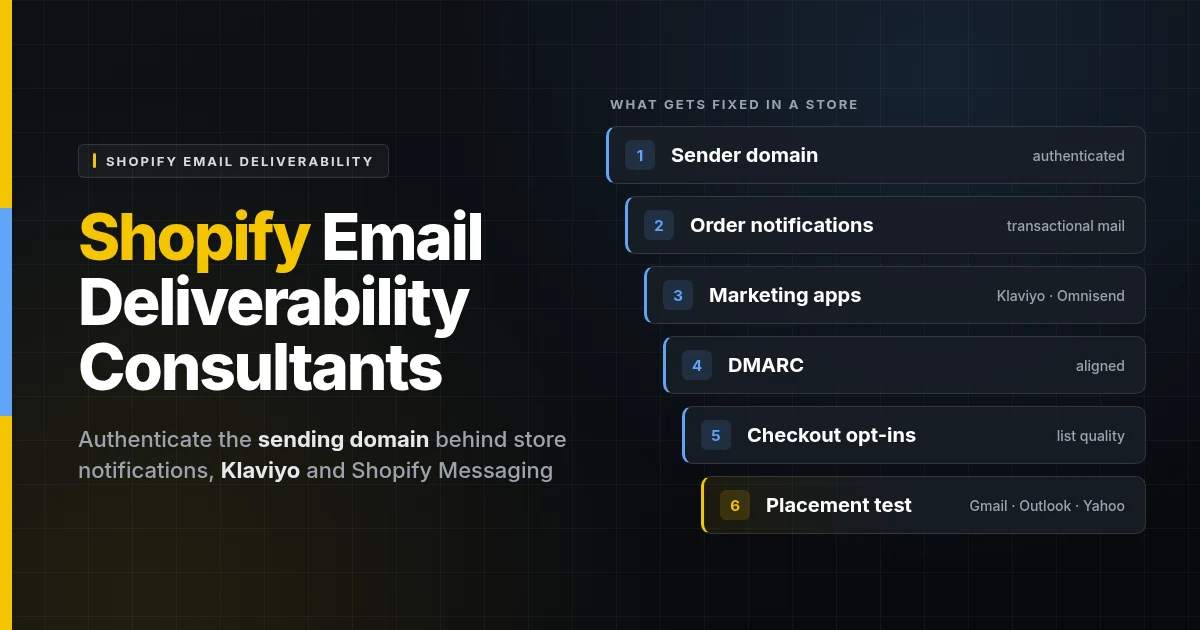
Shopify email deliverability consultants fix the reasons a store’s order confirmations and campaigns land in spam: a sender domain Shopify cannot authenticate, order mail and marketing sharing one reputation, and apps such as Klaviyo or Omnisend sending from shared domains. The good ones work inside Shopify’s settings, the marketing app and the store’s DNS, test placement at Gmail, Outlook and Yahoo, and write down every change.
Store owners usually go looking for one when customers say an order confirmation never arrived, or when campaign results fall away with no visible cause. Yeevu publishes this guide, and three of the options below (Yeevu, HelpWithEmails and YeevuFix) are Yeevu’s own services, so weigh those recommendations accordingly. The others are independent, and the questions near the end apply to every one of them.
What Shopify email deliverability consultants fix in a store
They fix three problems that are specific to how Shopify sends mail, on top of the authentication and reputation work any sender needs. Each one below is a setting a store owner can check, which also makes it a fair test of whether a consultant knows the platform.
Shopify sender email authentication and the shopifyemail.com rewrite
Shopify’s sender email is the customer-facing address used for automatic notifications, order confirmations and any marketing email the store sends. Since Gmail and Yahoo began enforcing their sender requirements on February 1, 2024, Shopify needs the domain behind that address to be authenticated. If it is not, Shopify rewrites the sender to an address like store+123@shopifyemail.com so the mail keeps flowing.
Keeping the branded address takes CNAME records, which set up DKIM and SPF for the sender email, and a DMARC record of at least v=DMARC1; p=none. A domain bought through Shopify is configured automatically. A domain registered elsewhere needs those records added at its DNS host, though Shopify can publish them automatically for a few providers that support Domain Connect.
A consultant’s job here is to confirm the records exist and pass on real messages, to make sure a new DMARC record does not clash with one that is already published, and to treat p=none as the starting point. It asks receivers for reports and protects nothing. Once every sender passes, the policy can move to quarantine and then reject.
Order notifications and marketing sharing one Shopify sender address
Shopify uses the one sender email for both order notifications and marketing sent from Shopify Messaging, the app formerly called Shopify Email (its old App Store address now redirects to Shopify Messaging). A promotion that draws spam complaints therefore leaves from the same domain as the order confirmation a customer is waiting for.
Volume adds up the same way. Gmail treats anyone sending close to 5,000 messages a day to personal Gmail accounts as a bulk sender, it counts every message from the same primary domain toward that total, and the status is permanent once reached. Order mail from Shopify and campaigns from a marketing app on send.yourstore.com both count toward yourstore.com. Gmail also recommends a consistent From address for each type of message, such as one for receipts and another for promotions.
Consultants decide which stream sends from where. The usual answer is to keep order mail on the store’s own address and move campaign volume to a marketing platform on its own subdomain, so a bad campaign cannot take the receipts down with it.
Klaviyo and Omnisend sending domains on a Shopify store
Many Shopify stores send campaigns and flows through a marketing app such as Klaviyo or Omnisend, and both start new accounts on a shared domain. Klaviyo accounts send from a shared domain that shows “via klaviyomail.com” until a branded sending domain is set up on an unused subdomain such as send. That takes up to three CNAME records or four NS records, depending on the routing type, plus a TXT record to verify ownership. Klaviyo treats the DMARC record as optional during setup, but Gmail and Yahoo require one from bulk senders. Omnisend likewise sends from its shared domain until the store verifies its own with the SPF, DKIM and DMARC records Omnisend generates.
Every other app that sends as the store adds another sender to authenticate: the helpdesk, review requests, subscriptions, the mailboxes on Google Workspace or Microsoft 365. The root domain’s SPF record is capped at ten DNS lookups, and each new include pushes it closer to failing outright. Keeping that list complete is most of what separates a lasting fix from a temporary one.
How Shopify email deliverability consultants work, step by step
A sound engagement follows the same order every time: find every sender, measure, fix, retest, and hand over a written record.
- Inventory every sender. Shopify notifications, Shopify Messaging, the marketing app, the helpdesk, review and subscription apps, and the staff mailboxes.
- Take a baseline. Read the headers of a real order confirmation and a real campaign (“Show original” in Gmail) for SPF, DKIM and DMARC results and alignment. Check the spam rate in Google Postmaster Tools, which Gmail wants below 0.1% and never at 0.3% or higher, and check the domain against the major blocklists.
- Fix authentication in Shopify, in the marketing app and at the DNS host, without breaking the SPF lookup limit.
- Separate the streams so order mail and campaigns carry separate reputations.
- Retest placement at Gmail, Outlook and Yahoo and compare against the baseline.
- Hand over a written report of every record changed, then watch DMARC reports so the next app install does not undo the work.
Yeevu’s email deliverability audit runs this way: a discovery session, then a full audit covering SPF, DKIM, DMARC, alignment, domain and IP reputation, list hygiene, inbox tests across Gmail, Outlook and Yahoo, and a blocklist check. A written report follows within 5–7 business days, with a severity rating for each issue, a prioritized fix list and a roadmap for rebuilding reputation.
Where to find Shopify email deliverability consultants
There are three routes: a deliverability specialist that works on Shopify stores, a Shopify or Klaviyo partner agency with genuine deliverability skills, or a testing tool if someone on the team can make the fixes.
Yeevu: Shopify email deliverability consultants with a free audit
Yeevu (the publisher of this guide) runs a free email deliverability audit, then provides a written quote before any remediation. Its engineers work across Google Workspace, Microsoft 365 and the major email marketing and CRM platforms, and the engineers who configure a setup are the ones who support it. Before an engagement starts, Yeevu sets out in writing who is accountable for each part of the work, and it says so if it is not the right fit. Its published e-commerce customer result describes restoring reliable transactional delivery for an online business by correcting authentication and alignment problems and validating the notification journey.
HelpWithEmails: Shopify email deliverability consultants for Klaviyo setup
HelpWithEmails is Yeevu’s own email deliverability service. Its email marketing setup covers Klaviyo, adding a branded sending domain so a store’s emails build the store’s own reputation, and its deliverability work fixes SPF, DKIM and DMARC and clears blocklist listings. Every job is quoted in writing first and ends with a written report. It also makes an inbox placement promise on stated terms: the quote names the mailbox providers the placement test covers, the test runs after the fix, and if mail lands outside the inbox, work continues at no charge until the test passes.
Shopify and Klaviyo partner directories for email deliverability consultants
The Shopify Partner Directory lists partners under an Email marketing category. Shopify tiers partners on factors including their experience and proven success on Shopify, and it suggests checking reviews, work samples and certifications. Klaviyo’s agency directory lists agency and solution partners that deliver Klaviyo strategy and services. Many of these firms are email marketing agencies first, building campaigns and flows. Ask directly whether they diagnose spam placement and fix DNS authentication, or only build campaigns. The difference is covered in deliverability consulting versus an email marketing agency.
Shopify email deliverability consultants compared
The table sets the options side by side. Prices are the ones each provider publishes; the partner directories list firms that set their own.
| Option | What it is | Price | Best for |
|---|---|---|---|
| Yeevu (Yeevu’s own) | Hands-on deliverability service | Free audit, then a written quote | Stores that want the cause found and fixed across Shopify, the marketing app and DNS |
| HelpWithEmails (Yeevu’s own) | Email deliverability and marketing setup service | Quoted per job, in writing | Klaviyo setup, and fixes proved with a placement test |
| YeevuFix (a Yeevu brand) | Fixed-scope, fixed-price fixes | Basic Audit $180, Full Audit $399 per domain | A small store with one specific problem |
| Shopify Partner Directory | Marketplace of Shopify partners | Set by each partner | Stores that want a Shopify agency and will vet its deliverability skills |
| Klaviyo agency directory | Klaviyo agency and solution partners | Set by each partner | Klaviyo-heavy stores that also want campaign strategy |
| GlockApps | Self-serve placement and spam testing | Free plan; $85–$185 a month | Stores with someone in-house to act on the results |
YeevuFix’s Full Audit adds blocklist checks and spam-placement reporting to the Basic Audit, and names Klaviyo among the platforms it works on. A GlockApps test sends to 115 seed addresses and runs content through five spam filters. More providers are compared in the top email deliverability companies.
How to choose Shopify email deliverability consultants: five questions
Five questions separate consultants who know Shopify from those who know email in general.
- Will they show the SPF, DKIM and DMARC results from a real order confirmation before changing anything? Evidence first is the habit that avoids fixes that make things worse.
- Do they cover every sender, not just the marketing app? Shopify notifications, the helpdesk and review apps all send as the store.
- How will they separate order mail from campaigns? A good answer mentions subdomains and Gmail’s count of everything sent from the primary domain.
- What exactly do they promise? No provider controls where Gmail or Outlook places a message. A promise means something only when it names the test and the remedy, as HelpWithEmails’ terms above do.
- Do they leave a written record of every DNS change? The next app a store installs will need adding to it.
When a Shopify store does not need email deliverability consultants
A small store may need no one. If the domain was bought through Shopify, only Shopify sends as it, volume is modest, and an order confirmation’s headers show SPF, DKIM and DMARC passing, the setup is probably sound. Open an order confirmation in Gmail, choose “Show original”, and read the three results. The free email domain scanner on the Yeevu platform gives a second opinion on the records. Bring in help when a marketing app or a second sender is added, when the spam rate in Postmaster Tools climbs toward 0.3%, or when customers say order emails are missing.
The records themselves are covered in DMARC and SPF setup consulting, and the wider picture for online stores on every platform in eCommerce email deliverability consulting.
Talk to Shopify email deliverability consultants at Yeevu
If order confirmations or campaigns are landing in spam, send Yeevu the store’s domain and the apps it sends through. The email deliverability audit sets out in writing what is blocking inbox placement and the order to fix it in, and the email deliverability services carry out the fix.
Book a free 30-minute consultation to go through where the store’s email stands today.