
Enterprise Email Deliverability Consulting Packages
On this page
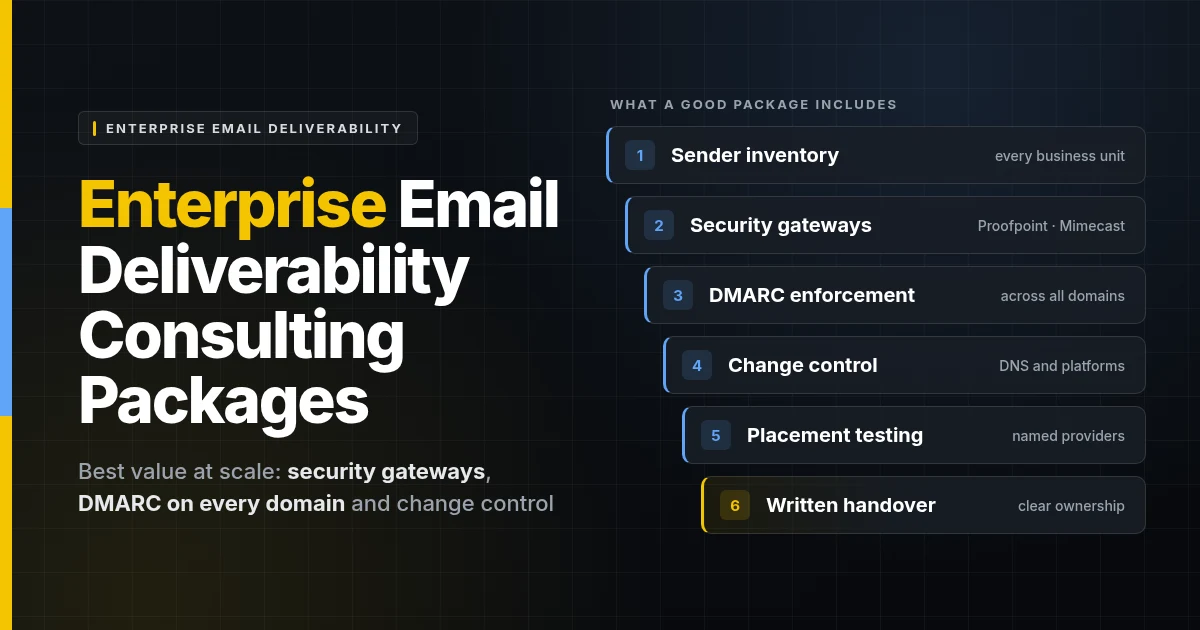
Enterprise email deliverability consulting packages give the best value when they are scoped to the whole sending estate, not sold as a per-domain checklist. A good package covers every domain, business unit, sending platform and security gateway; takes DMARC to enforcement across all of them; runs changes under change control; and ends with verified fixes and a written record, not a report your team still has to action. Price follows scope, so value is judged by what the package carries through to done.
It is written for IT, security and marketing operations leaders at organizations running many domains, brands or sending platforms, where one broken record can stop mail for a whole division. This guide sets out what “value” means at enterprise scale, what a good package includes, how pricing is set and which questions separate a real engagement from a rebadged audit. It is published by Yeevu, which sells enterprise deliverability work, so the section on Yeevu’s own approach is labeled as such.
Email Deliverability Consulting for Enterprise Companies: What Best Value Means
At enterprise scale, best value means the lowest total cost of getting mail delivered and keeping it that way, not the lowest day rate. Three things drive that cost, and none of them shows up in a price comparison.
- Coordination. A large organization’s mail passes through a registrar, a DNS provider, Microsoft 365 or Google Workspace, several marketing and transactional platforms, a CRM and often an outbound security gateway. When mail stops arriving, each of them can reasonably point at another. A package that covers only one layer leaves the gaps where most enterprise failures sit.
- Implementation. An audit that lists dozens of findings and leaves the fixes to an internal team that is already stretched has not reduced risk yet. Value comes from findings that are fixed and verified.
- Blast radius. On a single small-business domain, a wrong DNS change is an inconvenience. On an estate of dozens of domains, a DMARC policy moved to
p=rejectbefore every sender aligns can silently block payroll notices, invoices or password resets. Careful sequencing is worth more than speed.
What a Good Enterprise Email Deliverability Consulting Package Includes
A good enterprise email deliverability consulting package includes discovery, remediation, verification and documentation for every domain in scope, delivered by named engineers under written terms. Use the table below to check a proposal line by line.
| Component | What good looks like | Why it matters at enterprise scale |
|---|---|---|
| Sender inventory | Every platform sending as every domain, per business unit, confirmed from DMARC aggregate reports rather than memory | Undocumented senders are the usual reason enforcement breaks genuine mail |
| Authentication | SPF under the 10-DNS-lookup limit, DKIM signing with the organization’s own domain on every platform, aligned DMARC | Gmail and Yahoo (since February 2024) and Outlook.com (since May 2025) require it of senders of 5,000+ messages a day |
| DMARC enforcement plan | A per-domain path from p=none to p=quarantine and p=reject, including parked domains and subdomains |
Unenforced domains can still be spoofed in the organization’s name |
| Sending-stream separation | Marketing, transactional and person-to-person mail on separate subdomains with separate reputations | One business unit’s campaign cannot damage another unit’s invoices |
| Security gateway testing | Delivery tested into the gateways customers use (Proofpoint, Mimecast, Barracuda, Microsoft Defender), and the organization’s own outbound gateway checked | B2B mail can reach Gmail and still vanish inside a customer’s filters |
| Change control | Every DNS and platform change reviewed, recorded with its pre-change state and verified from outside afterwards | Mistakes are reversible and auditable |
| Monitoring | DMARC reports parsed across all domains, postmaster data and blocklists watched on a cadence, with named escalation | Reputation drifts after the project ends |
| Documentation and handover | A written record of every change, with the evidence that it worked | The next vendor or internal team can pick up without guessing |
Security Gateways: Where Enterprise Deliverability Work Differs
Security gateways are where enterprise email deliverability consulting differs most from small-business work, because they filter mail with their own reputation data and quarantine rules. Two problems recur.
Inbound to customers. Many larger companies screen incoming mail through Proofpoint, Mimecast, Barracuda or Microsoft Defender for Office 365. A sender can pass every Gmail and Outlook.com test and still have proposals quarantined on the way into a corporate buyer. A package should test delivery into the gateways your customers actually run, not just consumer mailboxes.
Outbound through your own gateway. When an outbound gateway or a Microsoft 365 transport rule appends a disclaimer or banner after a message has been DKIM-signed, the signature no longer matches and DKIM fails. At enterprise scale that can affect every message a department sends. The fix is to apply footers before signing, or to sign after the gateway, and it needs someone who can see both systems.
DMARC Enforcement Across Many Domains in Enterprise Email Deliverability Consulting
DMARC enforcement across many domains is a program of work, not a DNS record. Enterprises accumulate domains: regional sites, acquired brands, campaign microsites and defensive registrations. Each one can be spoofed until it has an enforced policy.
- Publish
p=nonewith reporting everywhere first, pointingruaat a tool that parses aggregate reports across every domain. Reports sent to an ordinary mailbox are not monitoring. - Lock down non-sending domains immediately. A domain that never sends mail can take
v=spf1 -allandp=rejectstraight away, with no risk to legitimate mail. - Align each third-party platform by setting up custom DKIM with the organization’s domain, and move platforms onto their own subdomains where one SPF record would otherwise exceed ten lookups.
- Move sending domains to
p=quarantineand thenp=rejectonly once the reports show every legitimate source passing, and set the subdomain policy deliberately rather than inheriting it by accident.
Enforcement also unlocks BIMI, the standard that displays a brand logo in supporting inboxes, which requires DMARC at quarantine or reject. For the record-level detail, see the guide to DMARC and SPF setup consulting.
Enterprise Email Deliverability Consulting for Multiple Business Units and Platforms
Where several business units each run their own platforms, enterprise email deliverability consulting has to establish one set of rules that every unit follows. In practice that means a register of who owns each sending platform, a naming scheme for sending subdomains (for example, separate subdomains for marketing, transactional and product mail), an agreed process for adding a new tool so it is authenticated before it sends its first message, and one owner for the DNS zone. Without those rules, the estate drifts back to where it started the next time a team signs up for a new platform.
Change Control for Email DNS and Platform Changes
Change control is what makes deliverability work safe on records that can take an organization’s mail offline. A good package names how changes are proposed, reviewed and approved, and it should include at least these practices:
- The existing configuration is captured before any change, so it can be restored exactly.
- Registrar and nameserver locking stays on, and access is least-privilege, per environment and protected by multi-factor authentication.
- High-risk records (MX, SPF, DMARC policy) change in a planned window, with a rollback step written down in advance.
- Each change is verified from outside the system (a real message, its headers and the published record) before it is marked done.
How Enterprise Email Deliverability Consulting Packages Are Priced
Enterprise email deliverability consulting packages are normally quoted per engagement, because the work scales with the estate rather than with seats. The main price drivers are the number of domains, the number of platforms sending as each domain, the number of business units that have to agree changes, whether security gateways are in scope, whether the consultant carries out the fixes or only advises, and whether ongoing monitoring follows the project.
For a sense of scale at the other end of the market, YeevuFix, a Yeevu brand for small businesses, prices a single-domain Basic Audit at $180 and a Full Audit, which adds blocklist checks and spam-placement reporting, at $399. An enterprise estate is scoped and quoted instead, and a proposal that prices dozens of domains as a multiple of a per-domain audit is usually leaving the hard part out. Enterprise monitoring platforms such as Validity sell on custom quotes too, so compare written scopes, not headline figures.
Questions to Ask Before Buying Enterprise Email Deliverability Consulting
The questions below separate a real engagement from an audit with an enterprise label.
- Who makes the changes? If the answer is “your team,” you are buying advice, and the price should reflect that.
- Which gateways and mailbox providers will you test against? A package that tests only Gmail, Outlook and Yahoo misses where B2B mail disappears.
- How will you move each domain to enforcement without blocking genuine mail? Look for a staged plan driven by DMARC reports.
- What access do you need, for how long, and how is it secured? Permanent global-admin access is a red flag.
- What do we have at the end? Expect a written record of every change and the evidence it worked.
- What do you promise? Nobody controls where Gmail or Microsoft place a message. Be wary of guaranteed open rates or inbox rates, and ask for the exact terms of any placement promise.
If you are still deciding whether to build this capability internally, see email deliverability consulting vs in-house experts, and for very large sending programs, high-volume email deliverability consulting.
How Yeevu Delivers Enterprise Email Deliverability Consulting
Yeevu delivers enterprise work as one technical relationship across domains, DNS, business email and deliverability, so the gaps between providers are not left to the client to manage. What the Yeevu Enterprise engagement includes:
- Written accountability before work starts. Yeevu sets out in writing who is accountable for each part of the estate, how to reach Yeevu and what happens when something fails, and provides detail for procurement or due-diligence processes on request. It says so if it is not the right fit.
- The engineers who configure the systems support them. The person investigating an incident is the person who understands the environment.
- Security controls. Least-privilege administrative access, multi-factor authentication, managed credential storage, registrar and nameserver locking, and change review on the records capable of taking an organization offline.
- An incident path. Detect, investigate what actually changed, escalate to the engineer who can fix it, resolve by the fastest safe route, and verify from outside the system before closing.
- Deliverability in scope. SPF, DKIM and DMARC alignment moved toward enforcement deliberately, sending-domain separation, reputation monitoring and remediation across Microsoft 365, Google Workspace and the major email marketing and CRM platforms, plus DNS configuration and migrations.
Yeevu publishes its customer results rather than a wall of logos, including an e-commerce email recovery that restored transactional email delivery and strengthened sender trust controls for an e-commerce operation.
Hands-on deliverability jobs can also be scoped through HelpWithEmails, which is Yeevu’s own email deliverability service arm. Its quotes can name corporate gateways such as Proofpoint, Mimecast, Barracuda and Microsoft Defender in the inbox placement test that runs after the fix; if mail lands outside the inbox in that test, the work continues at no charge until it passes. It is the only inbox placement promise in Yeevu’s offer, and it applies on those terms.
Book a Free Enterprise Email Deliverability Consulting Call
Most enterprise engagements start with Yeevu’s email deliverability audit: a discovery session, a full technical and reputational audit, and a written report in 5–7 business days with a severity rating for every issue, a prioritized fix list and a long-term reputation roadmap. Yeevu offers a free email deliverability audit, then a written quote before any remediation. See Yeevu’s email deliverability services for the full scope.
Book a free 30-minute consultation to go through your domains, platforms and gateways and what a package for your estate would cover.